
Stripchat Public Disclosure Report (CPSW-20260925-483)
Case ID CPSW-20260925-483
Stripchat rejected a complaint about a spoken disclosure of a user’s real name and upheld that outcome on appeal. Before the initial decision, Customer Support stated that moderators lacked access to public-show audio.
Privacy complaint handling and access to evidence from public livestreams
Prepared by CamPlatform Safety Watch
Revised public disclosure edition October 4 2026 MDT
Evidence cutoff October 2 2026 at 11:24 pm MDT; policies retrieved October 3 UTC
CPSW reference CPSW-20260925-483; Stripchat decision XFPN-0010022815
Support requests 3770706 and 3791971
Executive assessment
Stripchat rejected a complaint about a spoken disclosure of a user’s real name and upheld that outcome on appeal. Before the initial decision, Customer Support stated that moderators lacked access to public-show audio. Neither supplied decision explains how the spoken allegation was assessed despite that limitation. [E1-E3]
This is a serious privacy and safety concern as well as an accountability gap. The complainant’s observations identify a possible weakness in investigating harmful speech after a livestream. Stripchat should explain what evidence it reviewed, what it preserved and how users are protected when audio is inaccessible. A rejection of the complaint does not resolve those questions. [E1-E4]
The file does not include an authenticated incident recording, complete report and appeal submissions, or the investigation file. The reported disclosure remains unresolved. A finding that a violation was not found does not establish that the event did not happen.
Principal findings
| Finding | Assessment |
|---|---|
| Public show audio access | A limitation was expressly stated by Customer Support. Its exact technical scope remains unverified. [E1] |
| Initial and appeal decisions | Both rejected further action; neither supplied a case-specific explanation of the audio issue or evidence reviewed. [E2-E3] |
| Record preservation | Requested before the decision; no confirmation or inventory appears in the reviewed correspondence. [E1-E4] |
| Broader safety concern | The complainant’s observations warrant investigation of the ability to review harmful speech after a stream. [E4] |
1 Original complaint and scope of review
What was reported
The complainant’s September 25 email alleged that a broadcaster said his real first name without consent during a public stream between approximately 6:50 and 7:20 pm MDT and made a middle-finger gesture. It also alleged previous disclosures of his real name. The broadcaster is identified privately in the source correspondence and is called Broadcaster A in this public edition. [E1, source page 1]
The complaint asked Stripchat to investigate its privacy and abusive-behaviour rules, preserve available broadcast, chat, clip and moderation records, restrict or remove identifying material hosted on the platform, prevent further disclosure, handle identifiers confidentially and provide a case number and outcome. It offered secure identity verification if needed. CPSW was copied in this original email and expressly asked to consider public disclosure if the platform did not address the matter. [E1]
This was a request to investigate alleged conduct and preserve evidence. It was not a demand that Stripchat penalize a broadcaster without proof. Any review of the complainant’s own conduct would require separate evidence and would not, on its own, decide whether the privacy allegation was substantiated.
Records reviewed
We reviewed the original complaint and support thread, the initial moderation decision, the October 2 appeal decision, and an October 2 support-ticket update written by the complainant. We also reviewed a copied October 1 Customer Support response supplied in the conversation and the current public reporting, appeal, community and retention guidance. The source register identifies the provenance of each item. [E1-E5; P1-P6]
The October 2 update sets out the complainant’s observations and concerns about the consequences of inaccessible audiovisual evidence, including possible exploitation of a moderation weakness. The support statement about audio access gives a direct basis for examining that concern. We treat it as a serious safety issue requiring investigation. The update is attributed to the complainant; distribution through a support email does not make it a Stripchat admission. [E1; E4]
Method and limitations
Our assessment compares the stated complaint, the platform’s recorded responses and its published procedures. We distinguish what the documents show from reported events and technical questions that require access to platform records. We have not audited Stripchat’s infrastructure, interviewed its moderators or inspected retention systems.
No independently authenticated Stripchat audio or video, witness account, complete chat log, appeal submission text or internal moderation notes was supplied for this review. The existence of a report decision and appeal decision supports that those processes occurred, but does not disclose what evidence was submitted or evaluated. Screenshots from a different platform have not been used to prove this Stripchat incident.
No Stripchat account ban or retaliatory enforcement is demonstrated in the reviewed records. This report makes no retaliation finding. The allegation of repeated identity disclosure also remains unverified.
Protection of identifying information
We have removed the complainant’s name, email address and username, the broadcaster’s handle and URL, and Gmail account navigation identifiers from reproduced exhibits. Platform decision and support references are retained to permit a substantive response. Stripchat may be able to link those references internally. Original records are retained separately; the public report does not reproduce a broadcast or identify the broadcaster.
2 Chronology and case references
Times are MDT, UTC minus 6 hours. Gmail display times are consistent with support timestamps marked GMT plus 3 after conversion. The broadcast window is the complainant’s estimate.
| Date and time | Event | Source |
|---|---|---|
| Sep 25 6:50-7:20 pm | Reported incident window during a public livestream. | E1 p1 |
| Sep 25 8:00 pm | Original complaint sent to Stripchat with CPSW copied; preservation and confidentiality requested. | E1 p1 |
| Sep 25 8:27 pm | Support directs the complainant to the report form, invites evidence and cannot confirm preservation in advance. | E1 pp1-2 |
| Sep 26 12:55 am | CPSW acknowledges the complaint and assigns CPSW-20260925-483. | E1 pp2-3 |
| Sep 26 1:08 am | Support says moderators lack access to public-show audio evidence and warns that the report might fail. | E1 p3 |
| Sep 26 1:39 am | Initial decision finds no violations and takes no further action; offers appeal under XFPN-0010022815. | E2 p1 |
| Oct 1 2:45 pm | Copied support response acknowledges a formal notice and directs the reporter to the appeal button. | E5 |
| Oct 2 3:33 am | Appeal decision retains the original no-action determination and repeats decision XFPN-0010022815. | E3 p1 |
| Oct 2 10:33 am | Complainant posts an update with the appeal decision attached and raises broader safety concerns. | E4 p1 |
The audio limitation was communicated approximately 31 minutes before the initial decision email. This establishes the communication sequence, not the duration of the internal review or when evidence became unavailable. The reporting-form and appeal submission times are missing.
The original complaint header displays 8:00 pm; a quoted support marker corresponds to 8:01 pm. The one-minute difference does not affect the sequence.
References must be kept distinct
XFPN-0010022815 is the decision identifier, reused on appeal. 3770706 is the original support request; 3791971 appears in the later update. CPSW-20260925-483 is our reference. The complete internal linkage between these platform records is unknown.
3 Stripchat responses and appeal outcome
Initial support direction
Customer Support told the complainant to use Stripchat’s reporting system so the Moderation Team could review relevant account activity and available records. It invited screenshots or other evidence, said action would depend on the available evidence, and did not promise a particular outcome or confirm preservation. This shows an offered reporting route and an invitation to submit material. [E1, source pages 1-2]
Audio limitation stated before the decision
This statement concerns access to public-show audio evidence. It does not expressly say that no video exists, that no audio is ever recorded, that all staff lack access, or that live monitoring and automated systems are absent. Stripchat has not supplied a technical explanation of the statement in the records reviewed.
Initial no action decision
The email also offered an appeal. It did not identify the evidence reviewed, the applicable privacy rule, the handling of the spoken allegation, or the status of the preservation request. “Haven’t found” describes the review outcome; it does not expressly assert that the event never occurred.
Appeal decision
The appeal outcome establishes that the original decision was maintained. The supplied notice does not address what changed on review, whether additional evidence was considered, whether the audio limitation persisted, or why the privacy allegation failed.
Escalation response
The copied October 1 reply said general Customer Support does not handle advanced policy reviews or safety investigations and directed the original reporter to the appeal button for secondary moderation review. It identified an internal route, but did not answer the technical or policy questions raised. Its provenance is a supplied text copy, not an email-native export. [E5]
4 Published policy and the explanation gap
Privacy and harassment
The Community Guidelines prohibit unauthorized disclosure of private identifying information and harassment, and say decisions depend on context rather than an isolated word or unverified report. [P1]
Whether a first name identifies someone depends on the surrounding information, its connection to an account, prior disclosure, consent and audience knowledge. The allegation cannot be rejected or established solely because it concerns a first name. The gesture also requires context; the correspondence alone does not establish its target or whether it met a harassment threshold. These are questions for an evidence-based review of this incident.
Appeal reasons promised by the platform
Stripchat’s reporting policy describes an investigation based on evidence, a six-month appeal opportunity, reconsideration of reported content and additional material, and an explanation of reasons when an appeal fails. It also sets a maximum five-business-day resolution period for illegal or non-consensual content complaints. [P2]
The October 2 email identifies an unchanged result but gives no case-specific explanation of why the spoken privacy allegation could not be substantiated. In our assessment, the supplied notice does not demonstrate the explanatory standard described in that policy. A fuller separate explanation may exist, but none was supplied. The reporting and appeal submission dates are missing, so we do not make a deadline-breach finding.
Live safety tools and audio evidence
The current Terms describe identity checks, 24/7 manual moderation of content submitted for publication, automated message screening, computer vision alerts and third-party reports. They authorize monitoring and logging of streams and other activities. [P3]
Published safeguards do not resolve the complainant’s concern unless they permit reliable review of the reported conduct. Recording authorization does not establish that this stream was recorded, retained or accessible to investigators. Live detection and later evidence review are different capabilities. Stripchat should explain which safeguards were available and used here, and how they address spoken privacy violations.
Preservation and retention
The Privacy Policy permits longer retention for complaints or anticipated litigation but supplies no incident-specific public-stream retention period in the reviewed provision. [P4]
A preservation request can identify existing material for retention; it cannot create a recording that never existed. Here, the unresolved questions are what records existed when the request arrived, which could be preserved, what was preserved and whether any relevant material was overwritten. Lack of confirmation is a disclosure gap, not proof that records were destroyed.
Policy version and legal limits
The retrieved Community Guidelines show a September 1 2026 update; the reporting policy shows December 1 2025. The Terms displayed an effective date of October 3 2026 and a last-modified date of August 21 2026. We have no archived September 25 version. Current provisions are used as published context, without assuming every clause governed the earlier incident. [P1-P3]
5 Findings supported by the record
F1 An audio access limitation was stated
Established in the correspondence. A Customer Support representative expressly said the Moderation Team lacked access to public-show audio evidence and warned that the report might fail as a result. The technical reason, duration and reach of that limitation remain unverified. [E1]
F2 The evidentiary basis was not disclosed
Established for the supplied decision notices. Neither identifies whether audio, video, chat, screenshots, earlier complaints, live moderator observations or automated alerts informed the outcome. We cannot assess the completeness of the internal review from the outcome emails alone. This finding concerns the explanation provided, not an assertion that no investigative work occurred. [E2-E3]
F3 The appeal did not resolve the explanation gap
Established for the supplied appeal notice. An appeal route was offered and an outcome was communicated. The outcome repeats the no-violation finding without explaining the audio issue or reasons specific to the complaint. That falls short of demonstrating the reason-giving commitment described in the current reporting policy. The independence of the reviewer and the material submitted on appeal are unknown. [E2-E3; P2]
F4 Preservation remains unconfirmed
Established as a gap in the supplied record. Preservation was requested before the initial decision. The first support reply expressly declined to confirm in advance what could be preserved. No subsequent preservation acknowledgement, inventory or retention explanation appears in the reviewed correspondence. Actual loss or destruction of records is not established. [E1-E4]
F5 The underlying privacy allegation remains unresolved
Reported but not independently substantiated by CPSW. The original complaint gives a broadcaster, time window, alleged words and conduct, and a claimed history. We lack the underlying audiovisual evidence needed to verify that account. The decision notices reject action but do not explain whether the alleged conduct was disproved, considered permissible in context, or could not be substantiated. [E1-E3]
F6 A serious safety concern requires investigation
The complainant’s observations warrant investigation of a possible weakness affecting harmful speech after livestreams. Inaccessible audio can prevent verification of spoken disclosures, threats or prohibited offers when no reliable alternative exists. Support’s warning that this report might fail gives the concern a concrete basis. Stripchat should explain whether this limitation affects other reports and how it prevents exploitation. The extent of the weakness and any actual exploitation remain unverified. [E1; E4]
Overall finding
CPSW finds a material accountability gap and a serious unresolved safety concern. Stripchat acknowledged an audio limitation relevant to the complaint, rejected action and upheld that outcome without explaining how the spoken allegation was reviewed. The complainant’s observations warrant investigation, an evidence inventory and a preservation response. These documented gaps justify High privacy caution for users concerned about identity exposure. The allegation against Broadcaster A and any criminal exploitation remain unverified.
6 Public safety implications
Public livestreams can carry harmful conduct in speech, images or gestures that may not appear in chat. A process that can review text while lacking relevant audio may miss the evidence needed to assess a spoken allegation. The issue is whether there is a dependable route from detection or reporting to investigation and preservation, including after the broadcast ends.
| Hypothetical reported conduct | Capability that would need to be explained |
|---|---|
| Spoken disclosure of an identity | Review of relevant audio and context, linkage to a person, consent assessment and available corroboration. |
| Spoken threats or coercion | Urgent escalation, preservation of available speech and context, and review by trained personnel. |
| A verbal offer of prohibited material | A route to review the offer even when no material is uploaded or retained in text; appropriate escalation. |
| Visible non-consensual conduct or abuse | Live intervention where detected, preservation of available visual evidence, and assessment after a report. |
The complainant’s October 2 observations raise a serious concern that a weakness in reviewing audiovisual evidence could be exploited. The stated audio limitation makes that concern relevant to an investigation. A process unable to examine harmful speech may fail to substantiate a report even when the reported conduct occurred. Stripchat should explain how it detects, investigates and prevents such exploitation. This file does not verify a specific criminal incident. [E1; E4]
Safeguards should permit review without excessive exposure
An appropriate investigation route can combine live moderation, promptly triggered retention of available evidence, contextual chat and moderator notes, user-supplied material, and controlled access for trained reviewers. Any retention design should account for privacy, proportionality, security and deletion schedules. We recommend evaluating those options; we do not assume Stripchat currently implements all of them or that indefinite storage is necessary.
Separate regulatory context
The European Commission announced preliminary findings on March 26 2026 concerning minors’ access to Stripchat and other adult platforms. That is a separate matter and does not establish this privacy allegation or the audio-access issue. The findings were expressly preliminary. [P5]
The Commission’s supervision page records termination of Stripchat’s Very Large Online Platform designation on May 27 2025, with the additional VLOP duties ending four months later. This report does not treat Stripchat as currently designated or infer a particular statutory recording obligation from that historical status. [P6]
7 Information and improvements requested
CPSW requests the following case-specific information from Stripchat’s Moderation, Trust and Safety, Legal or Compliance team. Responses can protect other users’ identities and sensitive detection details while explaining the factual basis of the decision.
1 Preservation and inventory
Confirm what relevant records existed when the September 25 complaint and preservation request were received, what was retained, applicable retention periods, and whether any material became unavailable.
2 Evidence reviewed
Identify the categories of evidence considered in the initial investigation and appeal, including live observations, retained media, chat, submitted material, prior reports, moderator notes and automated alerts.
3 Meaning of the audio limitation
Explain whether the statement concerned non-recording, deletion, access permissions, team responsibilities or another restriction. State whether any authorized review team could recover incident audio.
4 Reasons for this decision
State whether the allegation was disproved, found not to violate a specified rule, unsubstantiated because of unavailable or insufficient evidence, or resolved on another basis. Explain the applicable privacy and harassment tests.
5 Appeal review
Identify the reviewing function, whether a different reviewer was used, what additional material was evaluated and how the audio limitation was addressed. Explain why the supplied outcome contains no case-specific reasons.
6 Relevant timing
Provide receipt, review and decision timestamps, with time zones, and any point when relevant evidence ceased to be available. Reconcile both support requests with decision XFPN-0010022815.
7 Alternative evidence and serious incidents
Explain the secure route for submitting authentic media and contextual evidence, and the route for escalating urgent audiovisual allegations when primary records are inaccessible.
8 Corrective action
If the limitation prevents reliable review, describe the proposed change, accountable team and completion date. This may include revised outcome language, retention triggers, reviewer access or a reasoned independent review.
Within 24 hours of receipt of this report, we request acknowledgement, confirmation of preservation of available relevant records, identification of the responsible review team and a substantive interim response. If a full technical response takes longer, give a firm completion date. These are CPSW’s requested response windows.
8 Platform response and corrections
Stripchat offered a reporting route and invited evidence, issued a no-action decision, directed escalation through its appeal route and upheld the original determination. Those responses are part of the record. They do not answer how the alleged spoken disclosure was investigated or address the complainant’s broader safety concern. CPSW’s assessment serves public awareness, prevention and deterrence and requires scrutiny of that unresolved issue. [E1-E5]
As of the evidence cutoff, the materials supplied to CPSW contain no case-specific evidence inventory, preservation confirmation or technical explanation of public-show audio access. This describes the reviewed file. It is not a claim that Stripchat has no such records elsewhere or that no other communication exists.
Opportunity to correct and respond
Stripchat is invited to identify factual errors, supply relevant evidence and provide a substantive statement. A five-calendar-day correction and response period is requested from delivery of this report to the platform. No delivery date, expiry date or expired response window is asserted in this edition.
A substantive response will be evaluated against the evidence and incorporated with an update date. Established factual errors will be corrected. Where interpretation remains disputed, CPSW will record the material disagreement and Stripchat’s position.
The assessment will be made on the basis of the evidence on file.
Conclusion
The documents establish that Stripchat received a specific privacy complaint, warned that inaccessible audio could prevent confirmation, issued a no-action decision and upheld that outcome on appeal. They do not explain how the alleged spoken disclosure was investigated or why the appeal failed in light of that limitation.
That explanation is necessary to assess the reliability of this complaint review. Stripchat should identify what it examined, what it could not examine, what it preserved and why its rules did not warrant action. An unsuccessful complaint remains a legitimate subject for scrutiny when the evidentiary basis of its rejection is unclear.
The documented audio-access limitation and unexplained decisions justify a precautionary public warning. We advise High privacy caution for users worried about their real name or identity being exposed. The complainant’s observations require substantive investigation of the ability to review harmful speech and prevent exploitation. That warning rests on the documented gaps; verification of the reported disclosure or any criminal incident remains outstanding.
Contact and report identity
Digital Safety & Accountability Foundation Team
CamPlatform Safety Watch
[email protected]
https://camplatformsafetywatch.com
CPSW-20260925-483
Prepared for public awareness, prevention and deterrence. This edition is a review of supplied correspondence and public policies, not a platform infrastructure audit or a court determination.
9 Source register and exhibit guide
| ID | Source and provenance | Public reproduction |
|---|---|---|
| E1 | Original September 25 complaint and support correspondence, including CPSW acknowledgement and September 26 audio statement. Current email-redacted copy reviewed. | Source pages 1-3. Page 4 contains only hidden-quote markers and print boilerplate and is omitted. |
| E2 | Initial report decision, displayed September 26 2026 at 1:39 am. Current email-redacted copy reviewed. | Source page 1. Boilerplate-only page 2 is omitted. |
| E3 | Appeal decision, displayed October 2 2026 at 3:33 am. Newly supplied Gmail PDF. | Source page 1. Boilerplate-only page 2 is omitted. |
| E4 | October 2 support-ticket update, displayed 10:33 am. Body authored by complainant, with appeal PDF listed as attachment. | Complete substantive source page 1. |
| E5 | October 1 Customer Support reply copied into the conversation, timestamp 23:45 GMT plus 3. | Transcription with recipient name removed. No email-native copy supplied. |
Exhibits reproduce correspondence, not proof of the broadcast allegation. Redactions remove identifying text and private navigation identifiers from underlying PDF copies before images are inserted. Original source appearance is otherwise retained. Existing email redactions remain in place. No independently authenticated broadcast is included.
Public policy sources
P1 Stripchat Community Guidelines. Privacy and harassment; page displays update September 1 2026.
https://support.stripchat.com/hc/en-us/articles/4410728008977-Stripchat-Community-Guidelines
P2 Reporting and Internal Complaint Handling System. Investigation and appeal reasons; update December 1 2025.
https://support.stripchat.com/hc/en-us/articles/22537205709585-Reporting-and-Internal-Complaint-Handling-System
P3 Stripchat Terms of Use. Sections 7 and 10; displayed effective October 3 2026 and modified August 21 2026.
https://stripchat.com/terms
P4 Stripchat Privacy Policy. Section 15 on retention for complaints and anticipated litigation.
https://stripchat.com/privacy
P5 European Commission preliminary findings dated March 26 2026. Separate background on minors’ access.
https://digital-strategy.ec.europa.eu/en/news/commission-preliminarily-finds-pornhub-stripchat-xnxx-and-xvideos-breach-digital-services-act
P6 European Commission supervision of designated platforms. Technius and Stripchat entry; termination of VLOP designation.
https://digital-strategy.ec.europa.eu/en/policies/list-designated-vlops-and-vloses
Public web sources were retrieved October 3 2026 UTC for the original October 2 MDT edition. This edition was revised October 4 MDT to strengthen the public accountability caution while retaining the existing High Privacy Caution and to clarify the assessment of the complainant’s observations. No new incident evidence was added. Historical policy versions were not independently archived. Original email exports and source hashes are retained in the working record.
Exhibit 1 Original privacy complaint
Source page 1 of 4. Allegations are the complainant’s account.
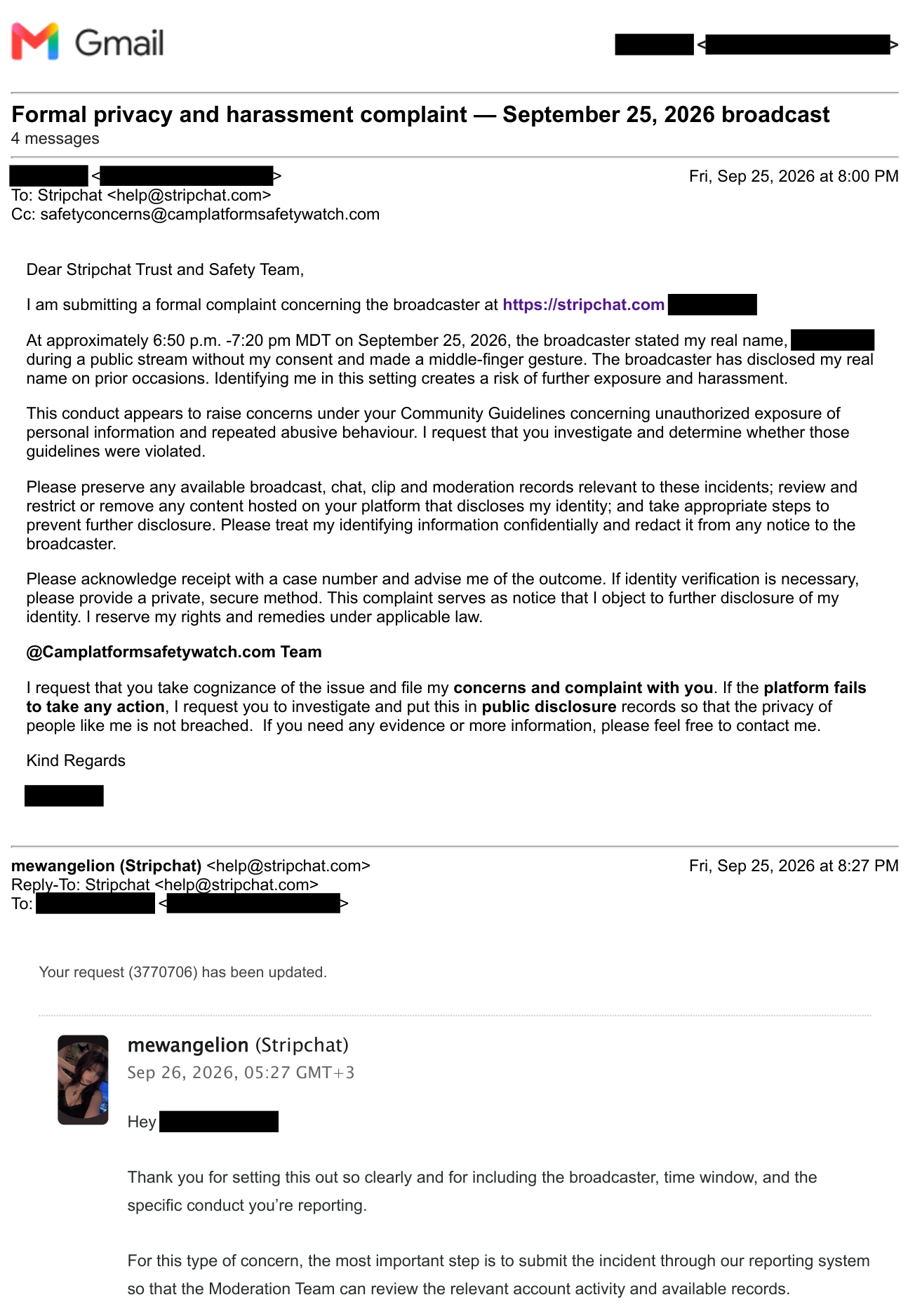
Exhibit 1 Reporting and preservation response
Source page 2 of 4. Includes CPSW acknowledgement.
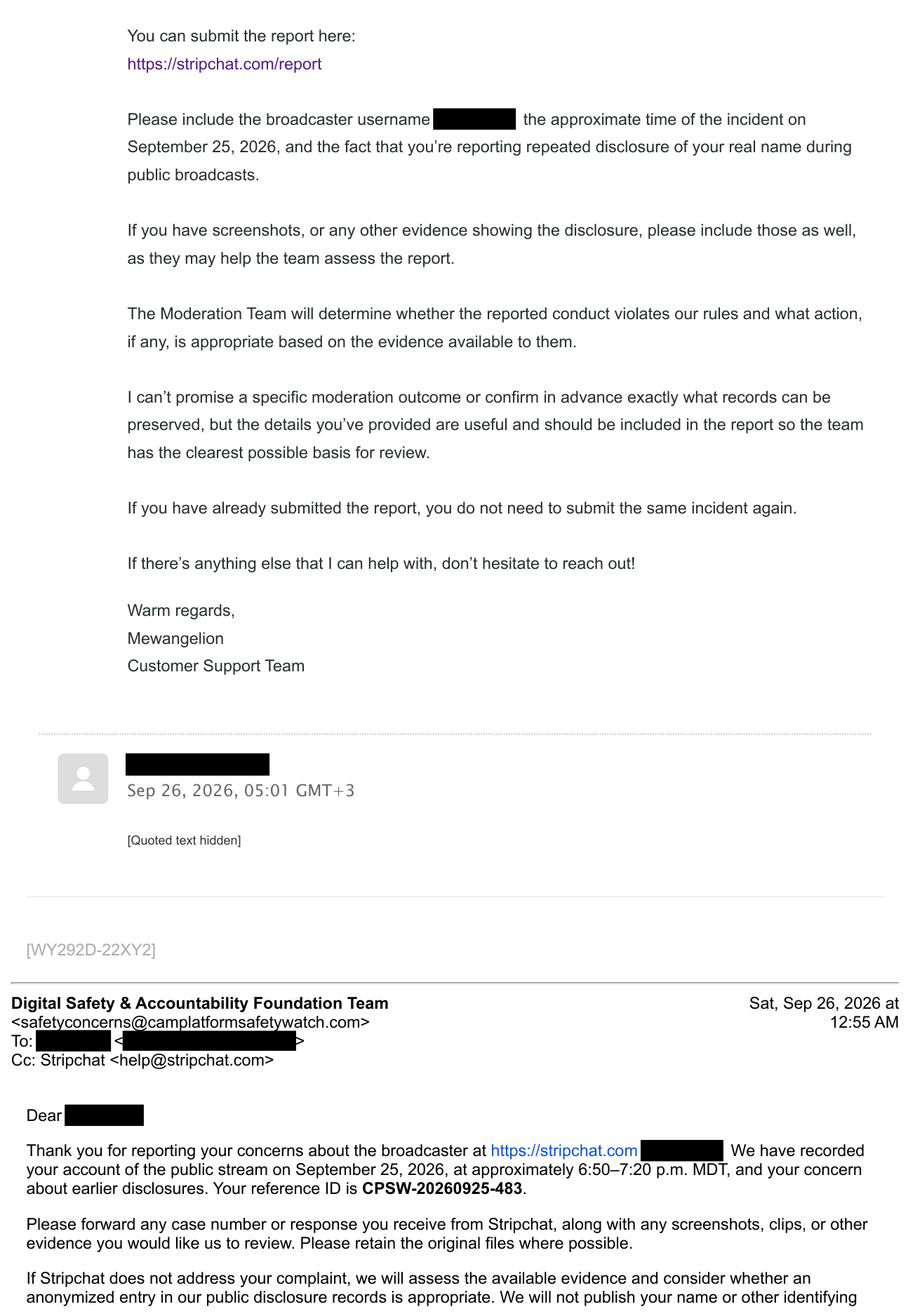
Exhibit 1 Public show audio statement
Source page 3 of 4. Statement attributed to Stripchat Customer Support.
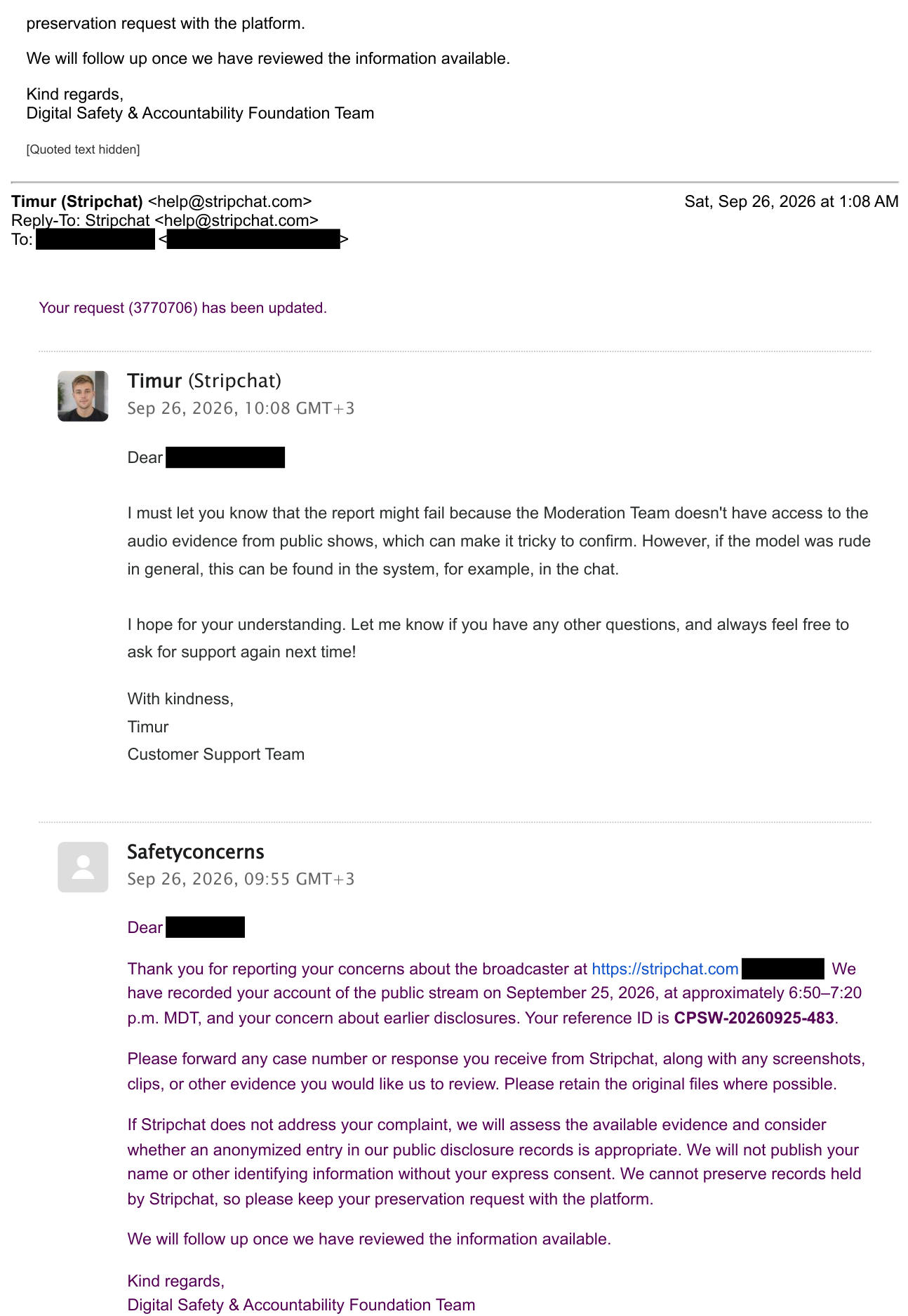
Exhibit 2 Initial report decision
Source page 1 of 2. Decision XFPN-0010022815.
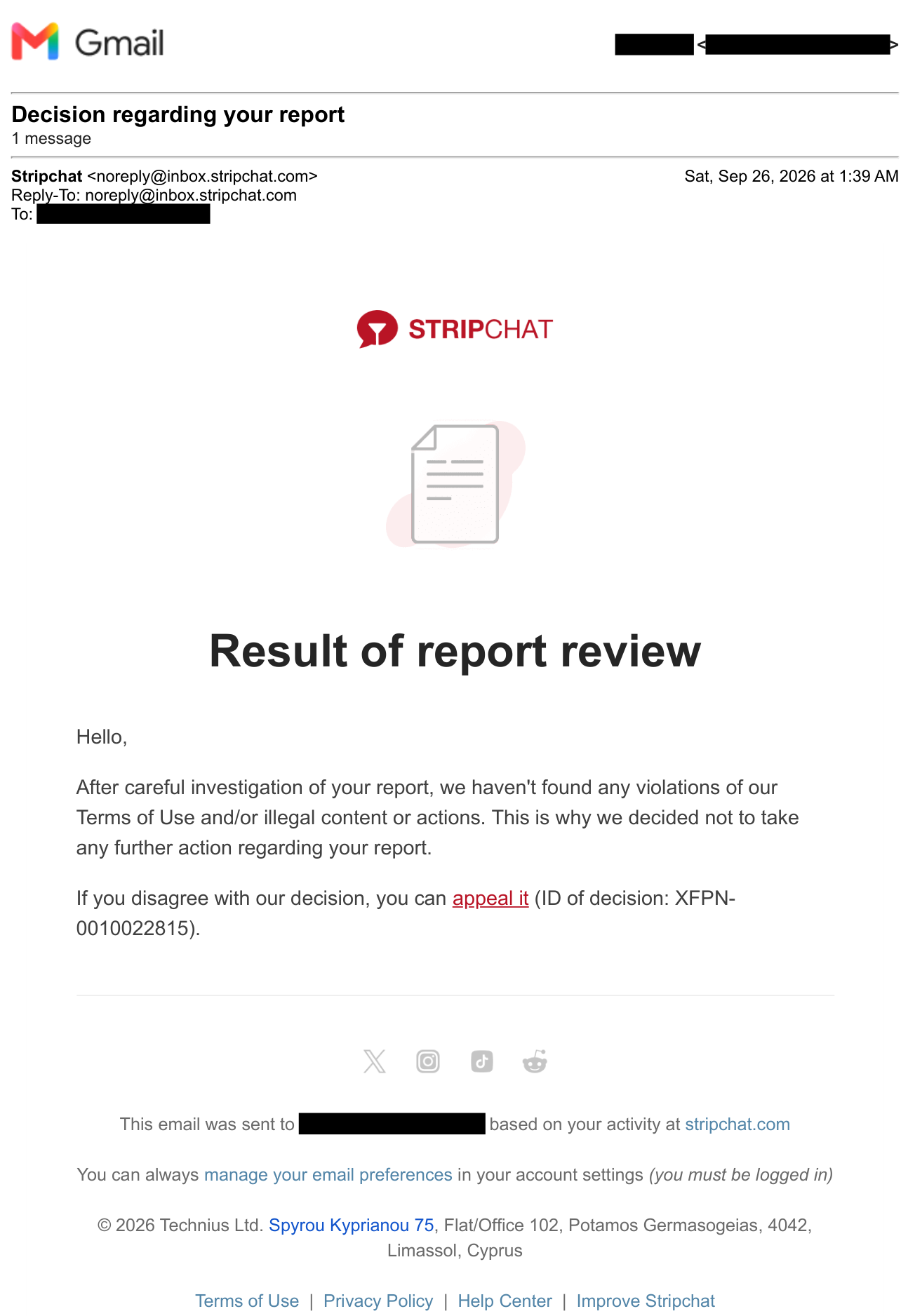
Exhibit 3 Appeal decision
Source page 1 of 2. Original decision maintained on October 2.
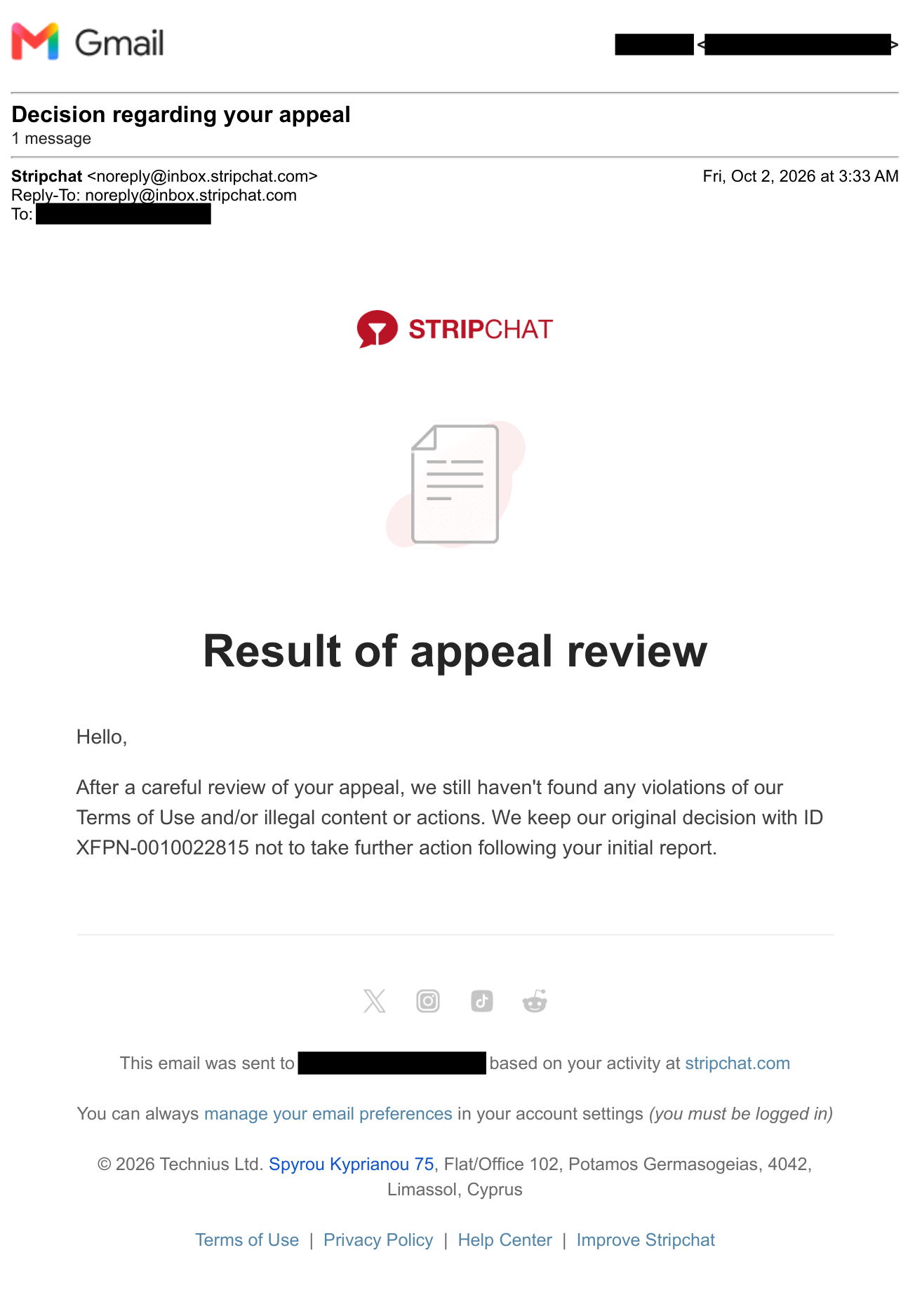
Exhibit 4 Complainant update after appeal
Source page 1 of 1. The complainant’s observations and safety concerns warrant investigation; this is not a Stripchat admission.
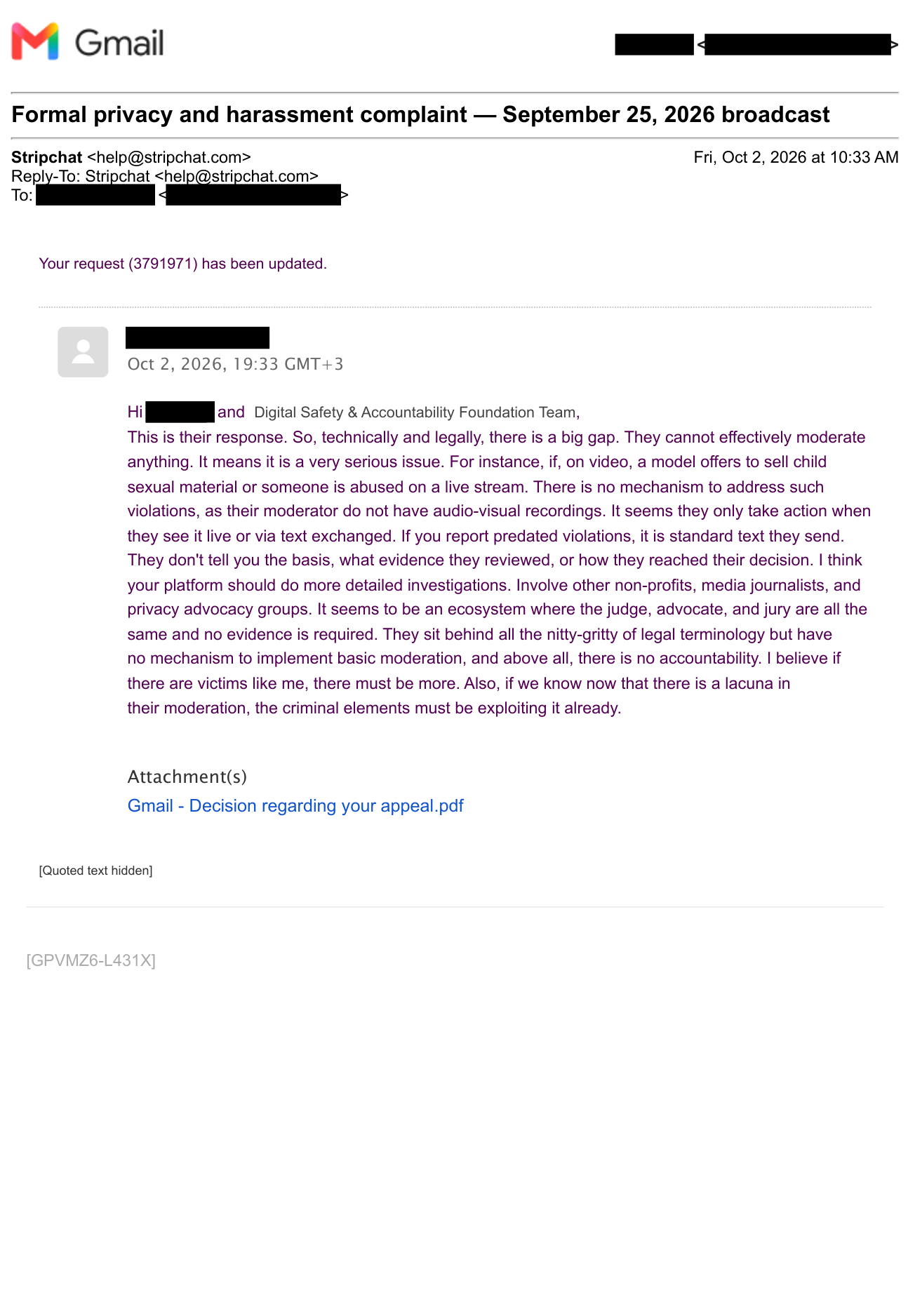
Exhibit 5 Customer Support escalation reply
Transcription of text supplied in the conversation. An email-native export was not provided. Recipient name removed; paragraph wording otherwise preserved. This item has a different evidentiary provenance from Exhibits 1 to 4.
Relevance and limit
The reply acknowledges a formal notice and directs the original reporter to an internal appeal route. It does not disclose the evidence reviewed, explain audio retention or confirm preservation. This transcript alone does not establish the precise contents or delivery time of the outbound notice, or expiry of any requested response period.